
In Texas, fault in most injury cases comes down to a single legal question: Was someone negligent? If the answer is yes, the negligent party and their insurer owe you compensation.
At Trujillo Gonzalez PC, our personal injury attorneys prove negligence for injured people in Dallas and across Texas. We handle every case on a contingency fee basis, so you pay no attorney’s fees unless we recover compensation for you.
So what is negligence, exactly, and how does it apply to what happened to you? Keep reading for what Texas law requires, how your own share of fault can change your recovery, and how our team builds the proof insurers can’t ignore.
What Is Negligence Under Texas Law?

Negligence is the failure to use the care a reasonably careful person would use in the same situation. That’s the basic negligence definition courts use across the country, and Texas follows it closely.
Texas juries hear it framed as a failure to use ordinary care, which the Texas Pattern Jury Charges tie to how a person of ordinary prudence would act under the same or similar circumstances. In other words, a person is negligent when they do something a prudent person wouldn’t do, or fail to do something a prudent person would.
Intent plays no role. A driver who glances at a text for two seconds never meant to hurt anyone, but Texas negligence law still holds them responsible for the harm that glance causes.
The 4 Elements of Negligence in a Texas Personal Injury Claim
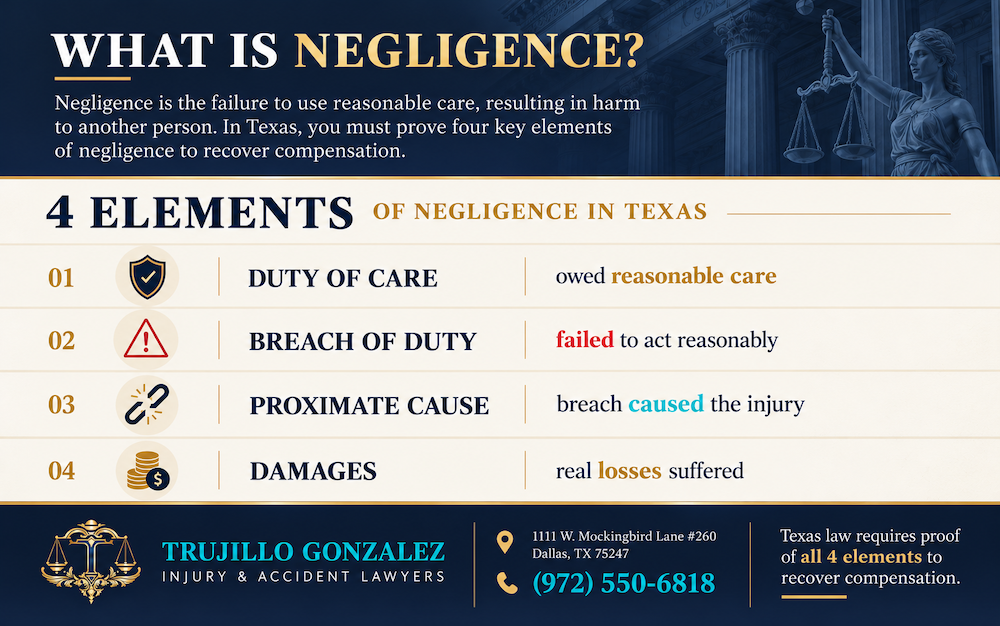
Knowing the definition of negligence is only the start, because Texas courts require specific proof for a claim to succeed. The Texas Supreme Court set out the framework in Doe v. Boys Clubs of Greater Dallas, and courts still apply it today: A legal duty, a breach of that duty, and damages proximately caused by the breach.
Most attorneys split that framework into the 4 elements of negligence below. We must prove each one, and if even one is missing, the claim fails no matter how badly you were hurt.
Duty of Care
A duty of care is a legal obligation to act reasonably toward others. Some duties are obvious: Every driver on I-35E owes everyone else on the road a duty to drive safely, and every store owes its customers a duty to keep the aisles reasonably safe.
Whether a duty exists is a question for the judge, not the jury. When no established duty applies, Texas courts weigh the risk involved, the foreseeability of the harm, and the likelihood of injury.
In most car crash, truck crash, and premises cases, the fight rarely happens over duty. The real dispute usually starts with breach.
Breach of Duty
A breach of duty happens when someone falls short of the care they owed. Running a red light, tailgating an 18-wheeler, and ignoring a broken stair for months are all classic examples.
The test is objective. A jury doesn’t ask what the defendant personally thought was safe; it asks what a reasonably careful person would have done in the same spot.
Our team proves breach with dashcam and surveillance footage, crash reports, phone records, maintenance logs, and witness statements. The stronger that record, the harder it is for an insurer to argue the defendant acted reasonably.
Proximate Cause
Proximate cause links the breach to your injury. In Texas, it has two parts, cause in fact and foreseeability, and you must prove both.
Cause in fact means the negligent act was a substantial factor in bringing about the harm, and the harm would not have happened without it. Foreseeability asks whether a person of ordinary intelligence should have anticipated the danger the conduct created.
Texas courts are strict here. If the defendant’s conduct did no more than furnish a condition that made the injury possible, proximate cause isn’t met, so we focus on evidence that ties the defendant’s specific choices to your specific injuries.
Damages
The last element is actual harm. A near miss, however frightening, doesn’t support a negligence claim by itself.
Damages include economic losses like medical expenses and lost wages, along with non-economic losses like pain and suffering, mental anguish, and physical impairment. Texas defines both categories in Section 41.001 of the Civil Practice and Remedies Code.
Common Examples of Negligence in Dallas
Negligence shows up in ordinary moments, which is why it sits at the center of most injury claims. Some of the situations we see most often include the following:
- Distracted driving: A driver reading a text on Central Expressway rear-ends a line of stopped traffic.
- Unsafe trucking practices: A carrier pushes a driver past safe hours or skips required brake inspections.
- Ignored spills and hazards: A grocery store leaves a leaking freezer puddle unmarked for an entire shift.
- Poor property security: An apartment complex leaves broken gate locks and dark parking lots unrepaired after repeated tenant complaints.
- Careless left turns: A driver turns across a motorcyclist’s lane without checking for oncoming traffic.
Each of these situations still has to satisfy all four elements before it becomes a viable claim.
Negligence Per Se: When Breaking a Safety Law Proves Carelessness
Negligence per se works as a shortcut. When someone violates a safety statute meant to protect people like you from the kind of harm you suffered, the violation itself can establish the breach of duty.
Texas traffic laws offer the clearest examples. The state’s speed statute bars driving faster than is reasonable and prudent for the conditions, and a separate law prohibits reading, writing, or sending electronic messages while driving.
Negligence per se doesn’t win a case on its own. We still have to show that the violation caused your injuries and that you suffered real damages.
Ordinary Negligence vs. Gross Negligence
Most injury cases involve ordinary negligence, meaning a careless mistake. Gross negligence is a separate category, and Texas sets a much higher bar for it.
Under Section 41.001(11), the conduct must involve an extreme degree of risk when viewed objectively. The person must also have actual, subjective awareness of that risk and proceed anyway with conscious indifference to the safety of others.
Picture a trucking company that knows a driver has failed multiple drug tests and keeps dispatching him anyway. That’s a far cry from a driver who simply misjudges a lane change.
Proving gross negligence opens the door to exemplary damages, also called punitive damages, which punish conduct instead of compensating losses. Texas requires clear and convincing evidence for these awards.
The law also generally caps them at the greater of $200,000 or two times economic damages plus up to $750,000 in noneconomic damages.
How Comparative Negligence Affects Your Recovery in Texas
Insurers almost always try to shift some of the blame onto you. Texas handles shared fault through proportionate responsibility, a form of modified comparative negligence.
Under Section 33.001, you can’t recover damages if a jury finds you more than 50% responsible. If your share is 50% or less, your damages are reduced by your percentage of fault.
Here’s how that plays out. Say a jury values your case at $100,000 and finds you 20% at fault for not signaling, so you recover $80,000; at 51%, you recover nothing.
That’s why every percentage point matters. We often push back hardest on comparative negligence arguments because a small shift in fault can change the outcome of the entire case.
Texas doesn’t follow pure contributory negligence, the harsh rule a few jurisdictions still apply, which bars any recovery if you were even slightly at fault. Under Texas negligence law, being partly responsible doesn’t automatically end your claim.
How We Prove Negligence in Your Case
Insurers don’t pay because a claim feels fair. They pay when the evidence makes negligence hard to deny, and our attorneys at Trujillo Gonzalez PC build that evidence through the following steps:
- Preserve evidence early: We send preservation letters quickly for dashcam video, surveillance footage, truck data recorders, and phone records before they’re erased.
- Reconstruct what happened: Our team visits the scene, reviews the crash or incident report, and brings in reconstruction experts when the facts are disputed.
- Interview witnesses: Witness accounts are strongest while memories are fresh, so we reach out right away.
- Connect your injuries to the incident: Working with your doctors, we make sure your medical records clearly tie each injury to the crash or fall.
- Document every loss: Bills, pay stubs, and treatment plans show the full value of your damages, now and in the future.
- Prepare for trial: We build every case as if it’s going before a jury, which gives us real leverage in settlement negotiations.
Each step aligns with one of the elements of negligence, leaving the insurer with little to pick apart.
The Deadline to File a Negligence Claim in Texas
Texas gives you 2 years from the date of the injury to file most personal injury lawsuits. For wrongful death claims, the 2-year clock starts on the date of death.
Two years passes quickly when you’re focused on treatment and getting back to work. Claims against government entities can carry much shorter notice requirements, so reaching out early protects both your deadline and your evidence.
Frequently Asked Questions
These are some of the questions we hear most often from people trying to understand negligence after an injury.
Can I still recover compensation if I was partly at fault for a crash in Texas?
Yes, as long as a jury finds you 50% or less responsible. Texas uses modified comparative negligence, so your recovery is reduced by your share of fault.
What is the difference between negligence and contributory negligence?
Negligence is the defendant’s failure to use reasonable care, while contributory negligence refers to your own carelessness. In Texas, your share of fault reduces your recovery instead of eliminating it, unless you’re more than 50% responsible.
Is negligence per se easier to prove in a Dallas car accident case?
Often, yes, because a violation like speeding or texting can establish the breach without debating what a reasonable driver would do. We still have to prove the violation caused your injuries.
Does gross negligence change how much I can recover?
It can, because gross negligence allows a jury to award exemplary damages on top of compensation for your losses. Texas requires clear and convincing evidence and generally caps those awards.
Who decides whether the other party owed me a duty of care?
The judge decides whether a legal duty existed, and the jury decides whether that duty was breached. In most car and truck crash cases, the duty of care is well established.
Hurt by Negligence? Contact Trujillo Gonzalez PC for a Free Case Evaluation
A jury finding of 51% fault can wipe out an entire injury claim in Texas, which is why insurers work so hard to shift blame onto the person who got hurt.
Our Dallas personal injury attorneys, led by founders James Trujillo and Ramon Gonzalez, build negligence cases with early evidence and trial-ready fault arguments. We push back on every attempt to inflate your share of responsibility.
We serve clients in English and Spanish, and we handle every case on a contingency fee basis. You pay no attorney’s fees unless we recover compensation for you.
Call us at (972) 550-6818 or contact us online to schedule your free case evaluation.